

Intro
On June 18, I published my thoughts on Abaxx (ABXX:TO), the Toronto-listed operator of a new commodity futures exchange based in Singapore. Late Friday, around midnight (!), the company posted its Q2 results. Three developments stand out:
Abaxx restated Q1 results and changed how it presents revenue and certain expense items.
The new disclosure format revealed that incentives consumed 99.96% of gross trading revenue in Q2 and more than 100% in Q1.
Abaxx disclosed a material weakness, yet its Q2 filings appear to be riddled with new errors and inconsistencies.
At the end of this note, I also provide a brief update on the trading quality metrics discussed in the original report, as well as some color on Upslope’s view of downside valuation.
Restatements & Thesis Confirmation
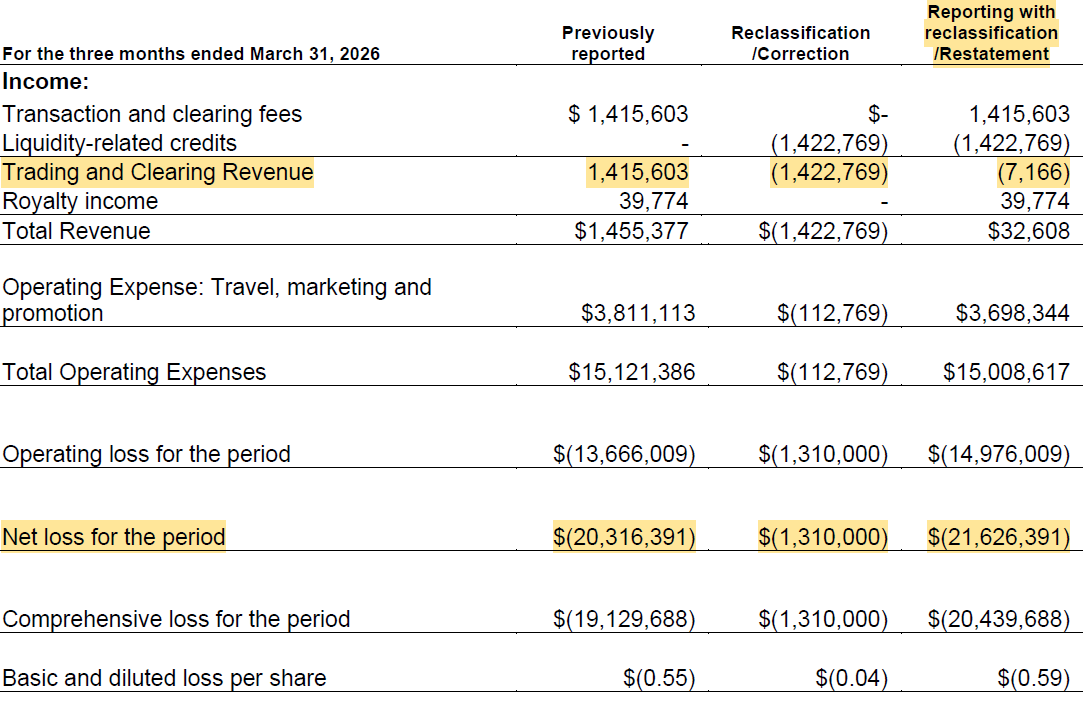
Abaxx restated its previously reported Q1 results, materially changing how it presents revenue and certain expense items, while slightly increasing its reported net loss. This restatement clarified just how heavily gross trading revenues depended on incentives.
Source: Abaxx 2026 Q2 Management’s Discussion and Analysis
As shown above for Q1, properly presenting “Trading and Clearing Revenue” net of “Liquidity-related credits” flipped reported revenue from C$1.4mm to negative C$7,166.
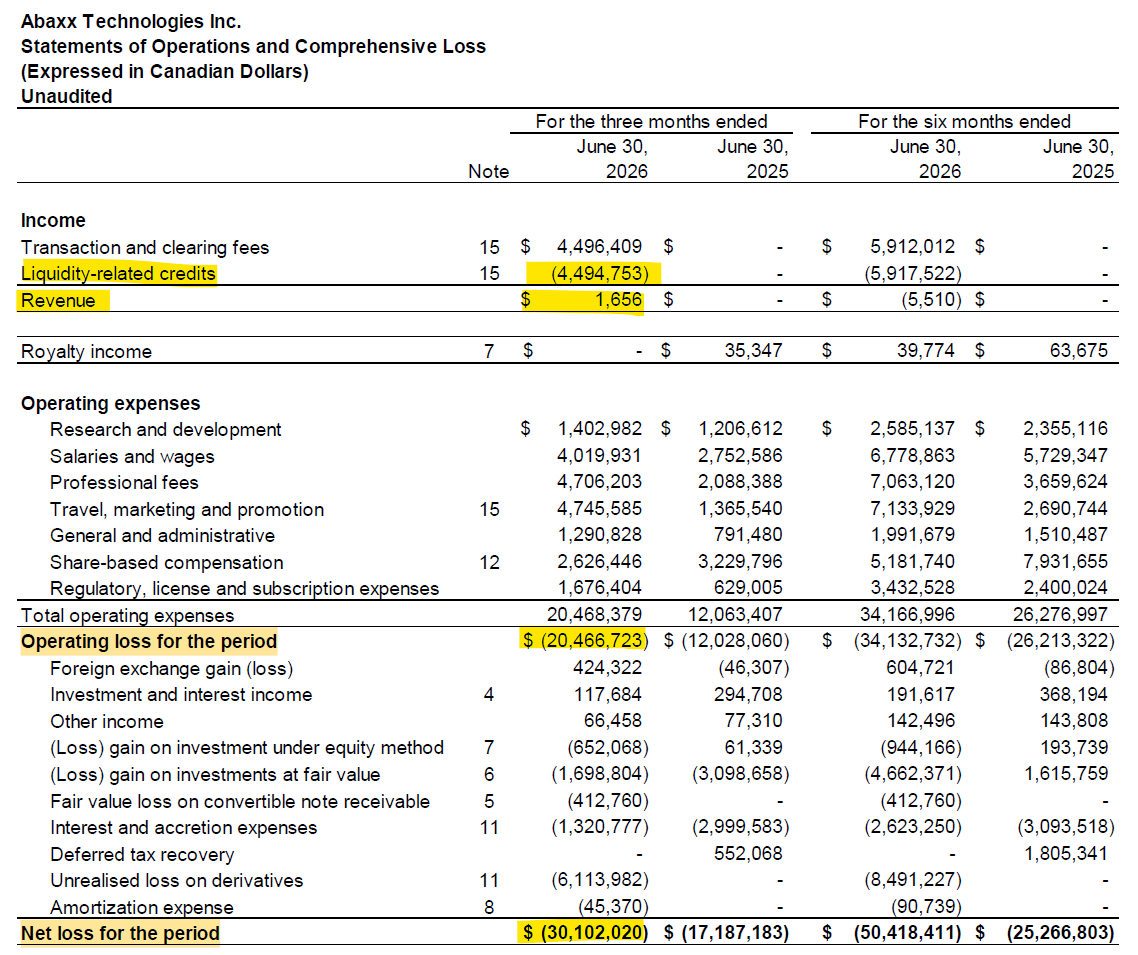
Q2 results showed (below) a similar story, but with larger numbers: C$4.5mm of gross revenue turned into just C$1,656 (less than two thousand Canadian dollars) of net revenue after incentives. In other words, “liquidity-related credits” offset 99.96% of gross “transaction and clearing fee” revenue. This resoundingly confirms Upslope’s thesis that the exchange’s aggregate economics have been virtually entirely incentive-driven.
Source: Abaxx Financial Statements for the three and six months ended June 30, 2026, and 2025
As I wrote in June, incentivizing early trading volumes is understandable and legal. But an exchange creates value only if and when it sustains meaningful independent volume and open interest.
Material Weakness & More Errors
Abaxx also disclosed a “Material Weakness,” a term that means there is a reasonable possibility that a material accounting-related misstatement won’t be prevented or detected in a timely manner. That disclosure is particularly concerning because even as Abaxx restated Q1 results, its Q2 filings appear to contain multiple new errors, inconsistencies, and typos.
Some are innocuous-but-extremely-obvious. For example, footnote #1 still describes the company’s stock as being listed on Cboe Canada, even though the listing was moved to the Toronto Stock Exchange (with much fanfare) in May.

Source: Abaxx Financial Statements for the three and six months ended June 30, 2026, and 2025
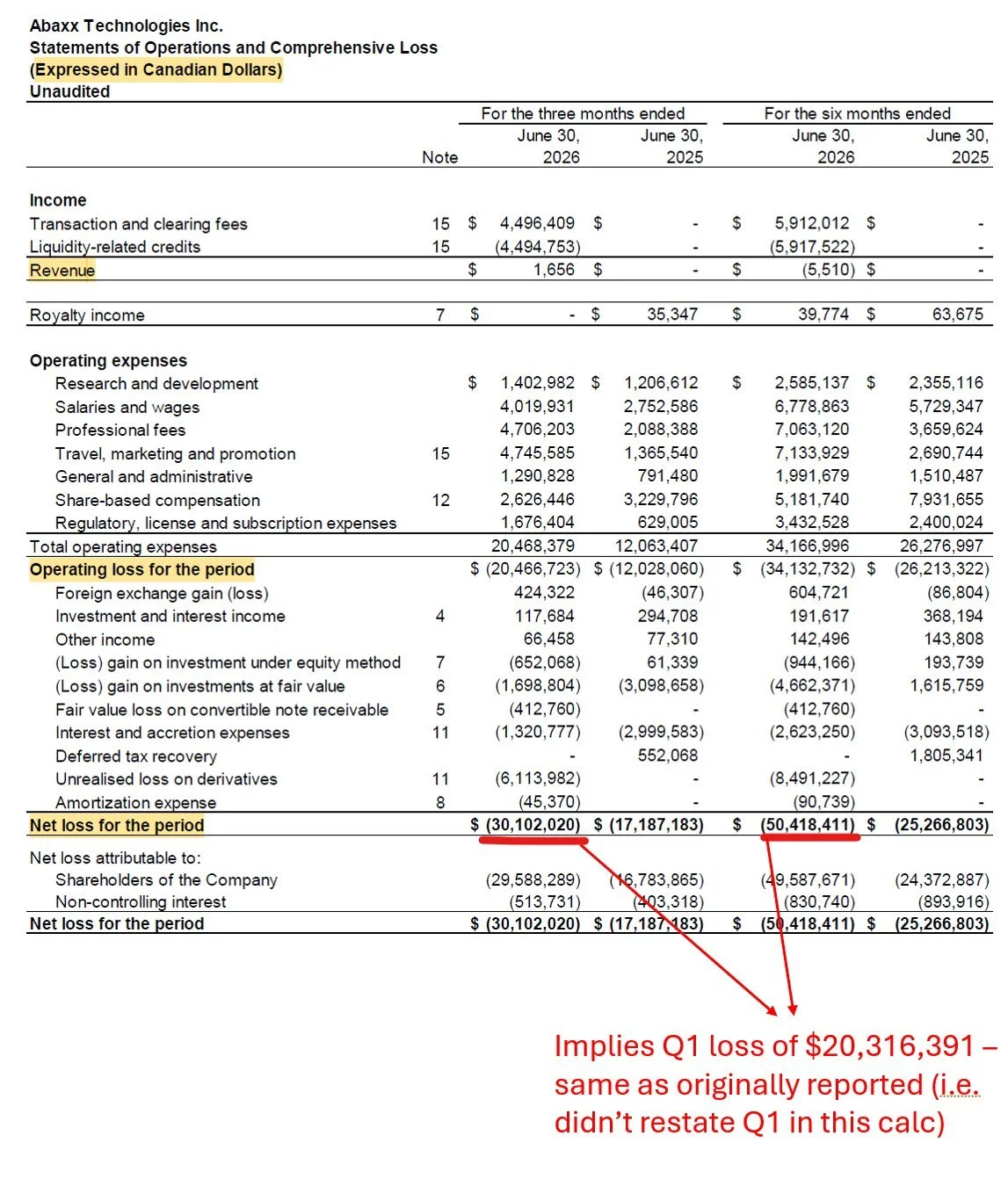
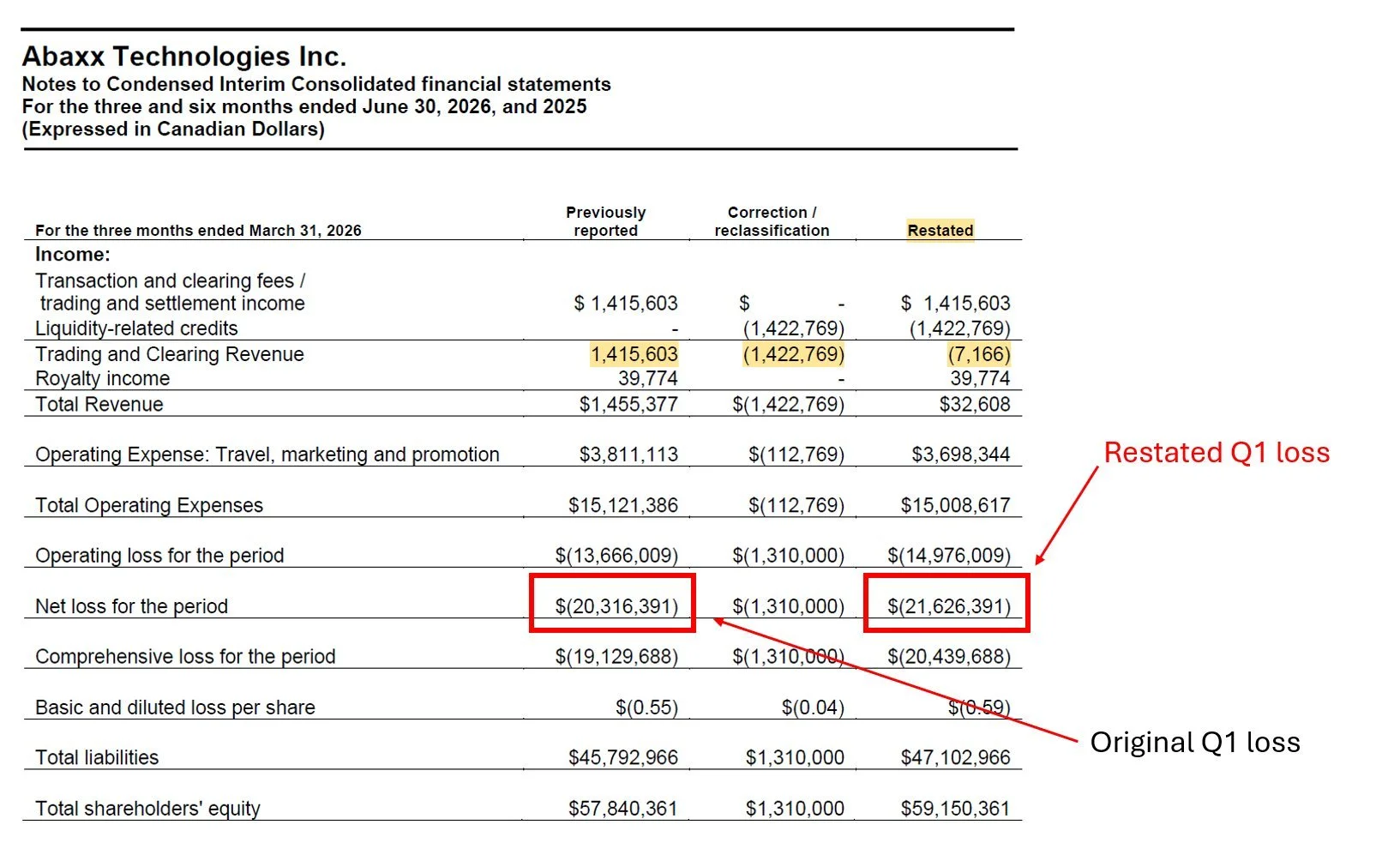
Other apparent mistakes are far more substantive. For example, Abaxx appears to have restated Q1 without the correction flowing through reported 1H results:
Source: Abaxx Financial Statements for the three and six months ended June 30, 2026, and 2025
Source: Abaxx Financial Statements for the three and six months ended June 30, 2026, and 2025
These are just two of many apparent errors. Given the recent restatements, errors, and likely future corrections, I would be surprised if we don’t see turnover in Abaxx’s senior finance function in the near term. If this happens, it will be interesting to see the speed with which Abaxx can fill the role, along with the quality of the candidate it’s able to attract.
Recent Trading Activity
The trajectory of the exchange’s trading metrics changed meaningfully during the 30 trading days following Upslope’s June 18 report:
Avg daily volumes rose 85% (vs. 30 days prior), but remained highly erratic — e.g., going from 9k to 118k to 7k contracts in the three days ending July 2. This is not the picture of a healthy, liquid market, in Upslope’s view.
Avg settle-out and low-range volume shares (see here for a reminder of how these metrics are defined) fell 63% and 66%, respectively — a drastic and sudden improvement. In contrast, avg OI/ADV (10d) worsened, from 5.5% to 4.7%. OI is the metric least susceptible to being flattered by incentivized, day-traded volumes. The divergence between these metrics seems notable.
Q2’s near-complete dependence on incentives, more recent OI/ADV weakness, and highly erratic trading (helpful for press releases, but little else) lead Upslope to believe that Q3-to-date activity remains as overwhelmingly incentive-driven as prior quarters.
Conclusion
In Upslope’s view, Q2 provided strong evidence that Abaxx has yet to spark meaningful, economically independent exchange activity: gross revenue was almost entirely offset by incentives, open interest remained negligible, and the company disclosed serious financial reporting deficiencies. Taken together, these developments further increase the probability that Abaxx fails to establish a successful, self-sustaining exchange.
One final comment regarding downside. Abaxx’s promoters have suggested that “salvage value” of the business roughly equals current equity value of ~C$1 billion. Upslope strongly disagrees. Since 2021, Abaxx has spent just ~C$200 million developing its business. Almost half went to stock-based and other compensation. A C$1 billion salvage value would value a failed business at roughly 5x its total historical spend. Based in part on 15+ years of experience following and investing in the exchange sector, Upslope believes a reasonable value in a failure scenario is C$100-200 million (including some credit for Abaxx’s other speculative and unproven assets) — implying 80%-90% downside.
Update - August 17, 2026
Abaxx has now “restated the restatement,” as it filed amended Q2 financials this morning just before hosting its earnings call. The company provided the below (seemingly non-exhaustive, as I see other edits not listed) summary of corrections. The filing contained a number of new typos.
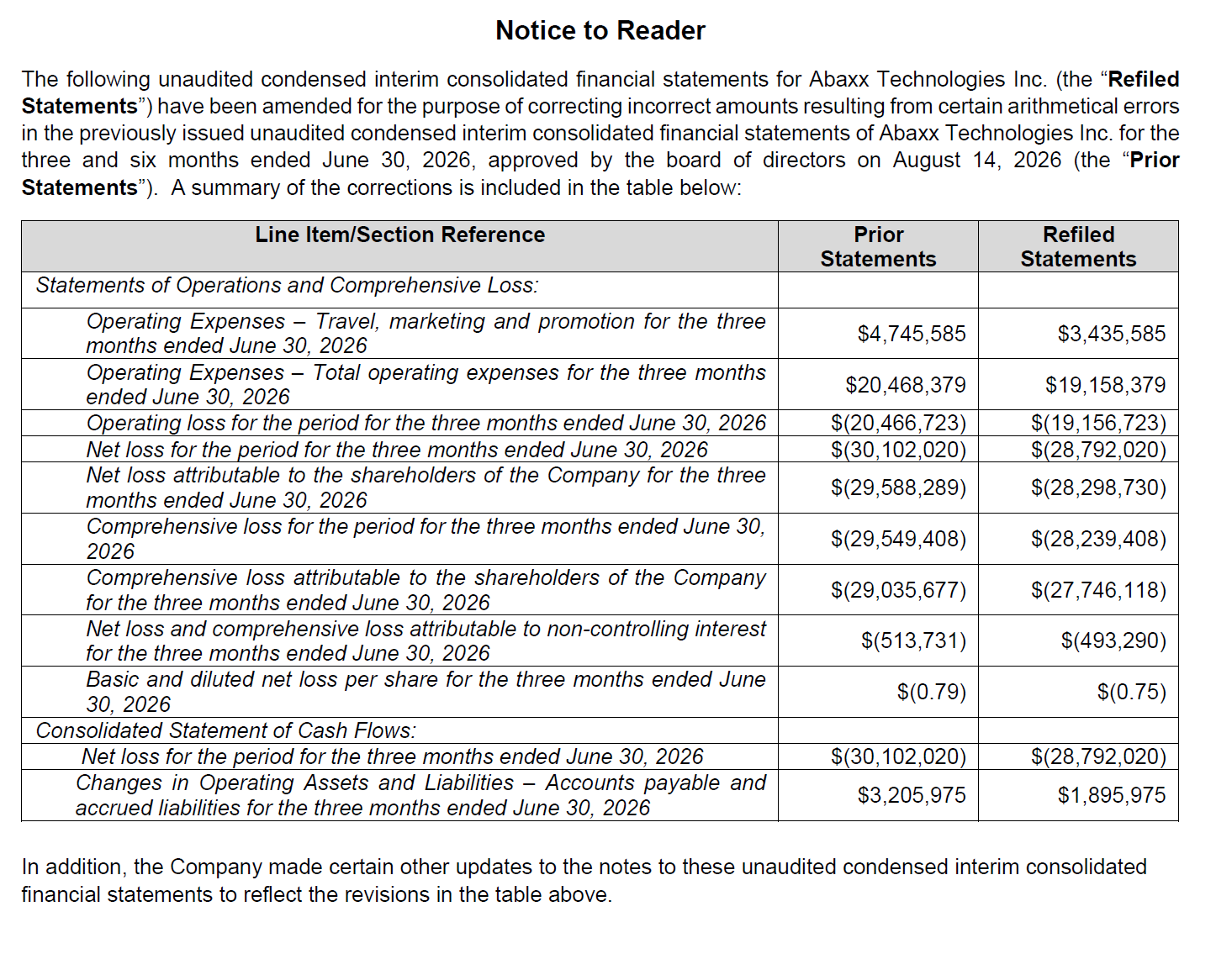
Source: Abaxx Financial Statements for the three and six months ended June 30, 2026, and 2025 (updated Aug 17, 2026)
Disclaimer:
As of this writing, Upslope and its clients are short shares of Abaxx Technologies and stand to benefit if the share price declines. Upslope and its clients are also long and short shares of various competing exchanges. While Upslope has no present plans to do so, these positions may change at any time, without notice, and Upslope is under no obligation to update this post. Nothing here is investment advice or a recommendation to buy or sell any security. Upslope also has no past or present affiliation with Viceroy or any of its employees, and nothing here should be read as an endorsement (or rebuttal) of their work – readers are encouraged to reach their own conclusions. The analysis reflects Upslope’s opinions and is based on data believed to be reliable, but accuracy and completeness are not guaranteed. Do your own work.